
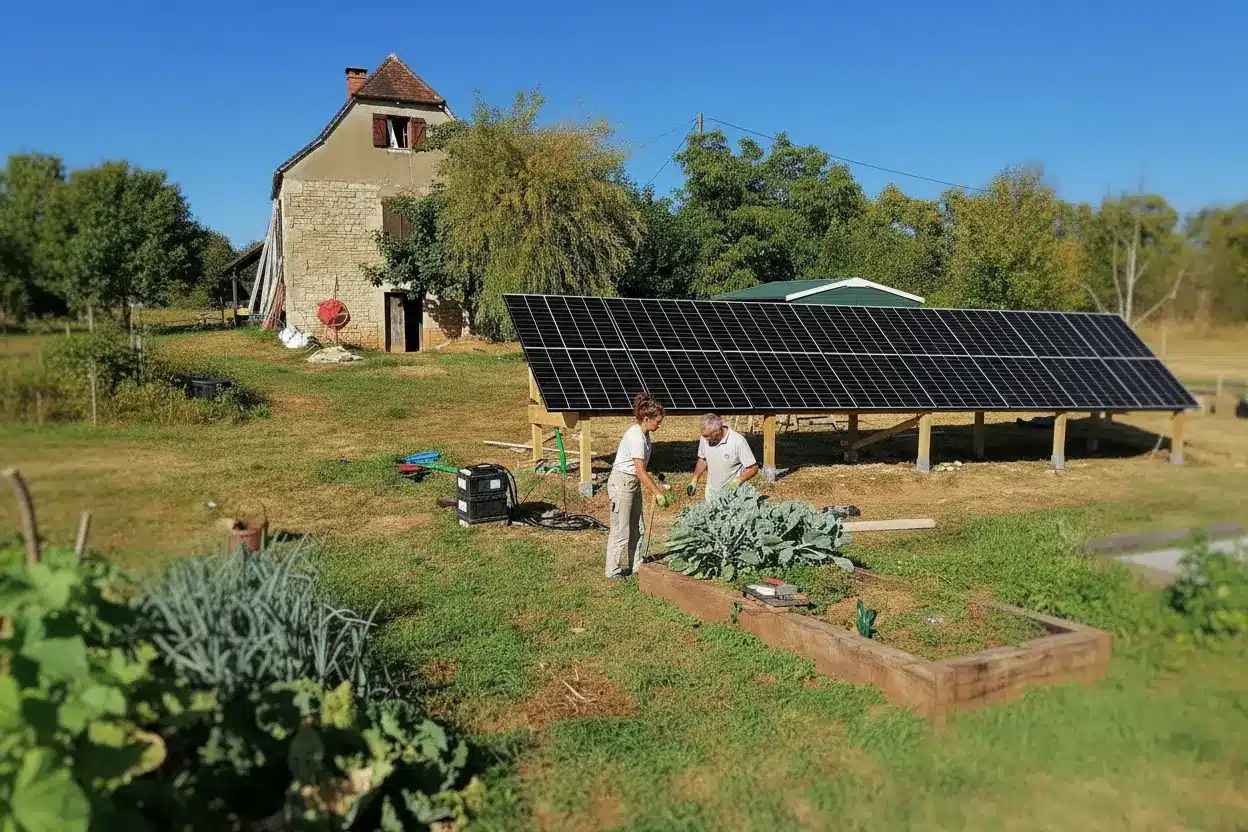
Whoever said installing a home solar power station required endless paperwork, sky-high bills, and a battalion of specialists clearly hasn’t met Audren Van Zalk. In just a few days—and with plenty of sawdust and ingenuity—this DIY enthusiast from rural Lot, France, single-handedly built a solar plant that will take care of more than half his home’s electricity needs. Saving money, cutting carbon, and charging his car: all in a weekend’s work!
Sunshine and Sweat: Building a DIY Solar Power Station
Audren’s journey began not with installers or hefty quotes, but with a hefty wooden frame. “It took me a long weekend to build the wooden structure, and another weekend to install the panels,” says Audren, who brings twenty years of construction experience to the table (sometimes literally). In the midst of the countryside, he set up an impressive 3.2 kWp photovoltaic station, capped at 3 kWp by the inverter—”to respect the Enedis convention,” he notes. Eight 400 Wp panels perch on a robust wooden support that he designed and built himself. It’s a project he enthusiastically details on his Twitter and YouTube accounts—collectively dubbed “Objectif ZeroCarbone.”
Audren has been itching to dabble in home renewable energy since he was 15. But, as a committed do-it-yourselfer living in the city, the dream had to wait. Lately, with energy prices rising and the looming threat of price caps jumping in 2024, he chose to finally tackle the technical challenge.
The Math: Solar Savings for the Win
Let’s talk numbers—because for Audren, this isn’t just about saving the planet, but the wallet too. After updating himself on all the latest photovoltaic regulations, he splurged €2,200 on hardware (panels, a 5 kW inverter, and AC/DC switch boxes, delivery included). Add €250 for timber, €150 for grounding wires, and €100 for assorted fixings, and you arrive at a total bill of €2,700. Not bad at all. With a cost of just €844 per kWp for a ready-to-go solar station, Audren’s total spend is significantly lower than the going rates of €1,500–€3,000 per kWp charged by professionals.
- Panels & electricals: €2,200
- Wood for structure: €250
- Ground wire: €150
- Misc hardware: ~€100
- Total: €2,700
And instead of jumping through administrative hoops for surplus energy payments, Audren sidestepped the red tape: any electricity not immediately used is injected free of charge into the grid. That meant no approval needed from Consuel, and no wrestling with the strict technicalities required for remuneration.
Clever Use: Charging Cars, Heating, and Smarter Living
Could Audren have maximized his solar setup with a home battery? Absolutely. Why didn’t he? “I didn’t add a battery because my electric car—a Renault Zoé 22 kWh—absorbs a lot of the production,” he explains. Rather than sending surplus juice to the grid, his trusty Zoé soaks up much of the solar bounty. “A battery would have doubled the installation cost and would’ve greatly increased the payback period,” he tweets.
The solar production isn’t just about cars, though. Audren uses an electric water heater and is adding an air-to-air heat pump into the mix. For now, he juggles household loads manually—turning on devices with smart plugs when sunshine is plentiful or if the inverter is dumping too much on the grid. “When I know it’ll be sunny, or see a production spike, or when the inverter sends too much to the network, I trigger devices manually,” he says. Automation is coming, though: he plans to install load-shedding systems to handle optimization without manual intervention.
Unlike most solar stations, Audren’s isn’t facing due south. Instead, it tilts slightly west, tailored to produce more juice in the evenings to suit his household’s usage. This setup delays peak production in the morning, but optimizes energy generation for later in the day.
Results, Payback, and a Greener Home
Annually, Audren expects about 3,200 kWh of solar electricity—of which roughly 2,000 kWh feed his Zoé EV. The remaining 1,200 kWh covers about 25% of his family’s electric needs (out of an annual 11 MWh). Once his heat pump and an automated control system are up and running, he estimates the family’s consumption will fall to 6 MWh a year and the solar share will climb to 50%.
The household—a charming 200-year-old, 90 m² stone house with three residents—is heated with a wood stove and soon a reversible heat pump, which will soon boot out the old “toaster” radiators. “Everything in my house runs on electricity. I hardly use hydrocarbons anymore,” Audren boasts.
Electricity bills currently average €200 per month, but Audren claims he can shave off €450 in annual costs through solar self-consumption. At that rate, the investment will theoretically pay for itself in about five years—excluding the cost of lumber, since as Audren cheekily notes, the wood structure is also an indispensable woodshed.
In summary: no installers, no eye-watering bills, and no waiting for the cavalry—just one determined DIYer, a few weekends, and a lot of sunlight. If you ever doubted your own ability to build a solar station, Audren’s story should give you the spark you need. Literally.

Based in New York, Josh is the creative mind behind Lanco Handmade Furniture.
Passionate about timeless design and fine craftsmanship, he transforms high-quality materials into pieces that are both functional and artful.
With a keen eye for detail and a love for natural textures, Josh creates furniture meant to bring warmth, character, and lasting beauty to any space.